Everton Independent Research Data

EVERTON FOOTBALL PLAYERS REUNION AT LLANDUDNO
Liverpool Echo - Thursday 09 August 1906
To-day the Everton football players- prepare to read of them regularly described as “English Cup holders,” lest we forgot- entered upon their preparations for the campaign of 1906-7. There is ground for believing that they have set their eyes on the League Championship Cup. Well, it would save the F.A some railway fare money if the Liverpool club had to hand over the shield to their neighbours. Liverpool, of course, will have a say in the matter. To-day, at any rate, the Blues in charge of the never-fagging Jack Elliott, set out for a long walk into the country, and tomorrow they will renew acquaintance with the ball, and will indulge in ball practice and a printing. At this time of the year all the men commence on the east list; there can be no sudden burst into strict training; there must be a gradual pulling down of the superfluous fat. By the 18th of this month, when the first practice match is to be played, they will have worked into good condition. They will practice a second time before the public on the 27th, owing to the Liverpool club holding a preliminary trail on the 25th at New Brighton Tower grounds.
Yesterday the players went to Llandudno. This party is an annual affair, which as a reunion of the members is a capital idea. It gives the new players a chance of forming an acquaintance with their clubmates. And talking of new players. I would remark here that George Wilson, who with his brother, David, will make Goodison their headquarters, was married about a fortnight ago. The party mustered thirty-five at Llandudno, and dined at the St. George’s Hotel. Then two coaches carried them to Penmaenmawr, by way of the Sychnant Path, the return journey being made along the coast. It was a beautiful drive, and a capital outing. Mr. Secretary Cuff ought to open in the touring department. He had charge of the party of forty who commemorated winning of the Cup by visiting Epsom and Brighton, and yesterday was busy in making all comfortable on the Welsh journey.
If you will turn to our advertising columns you will see that there has been a reduction in the price of the Everton season tickets. Formerly the prices have ranged as follow;-
Single (shilling stand), 12s 6d; self and lady, 17s 6d; two shilling stand, 17s 6d and 25s; three shilling stand, a guinea and 30s. the figures now read in order;-
10s 6d and 15s, 15s and 21s, and 21s and 25s.
FOOTBALL CUP WINNERS IN TRAINING
August 10, 1906. The Liverpool Daily Post and Mercury
The Everton footballers started training yesterday. They set out for a long walk into the country, and today they will renew acquaintance with the ball, and will indulge in ball practice and sprinting. By the 18 th of this month when the first practice match is to be played, they will have worked into good condition. They will practice a second time before the public on the 27 th , owing to the Liverpool Club holding a preliminary trial on the 25 th at New Brighton Tower grounds. On Wednesday the players went to Llandudno, there being a reunion of old and new players. George Wilson with his brother, David will make Goodison their headquarters was married about a fortnight ago.

GRUNDY
Berkshire Chronicle - Saturday 11 August 1906
Reading New Players
H. Grundy, from Everton Reserves, is the new outside left. Grundy only played in three League matches during the season for the Everton League team, but the consistent brilliance of Hardman, the amateur international, prevented him from having the scope to show his ability. He was transferred from Chirk in Wales in October last year, and played good football in the Combination team. He is only 22, weighs 12st, and stands 5ft 8ins., and is a speedy forward. He has won about £80 in prize money for running, and has an excellent reputation as a player.

WILLIAM OWEN
Birmingham Daily Gazette - Monday 13 August 1906
On Saturday morning William Owen, formerly a well-known half-back in the Wolverhampton Wanderers’ team, died at the Three Crowns Inn, Little Park Street, Wolverhampton, of which he was the landlord.
Owen retired from football field about seven years ago, but at his best he was one of the finest half backs in the League. He first joined the Wanderers in 1892. He migrated to Loughborough for a season, but returned to Wolverhampton. In 1898 he signed on for Everton, with whom he last played. Owen, who was 35 years of age, leaves a widow and one child.
WILLIAM OWEN
Birmingham Mail - Monday 13 August 1906
On Saturday morning William Owen, formerly a well-known half-back in the Wolverhampton Wanderers’ team, died at the Three Crowns Inn, Little Park Street, Wolverhampton, of which he was the landlord. Owen retired from football field about seven years ago, but at his best he was one of the finest half backs in the League. He first joined the Wanderers in 1892. He migrated to Loughborough for a season, but returned to Wolverhampton. In 1898 he signed on for Everton, with whom he last played.
A HALF-BACK’S DEATH
Liverpool Evening Express - Monday 13 August 1906
Birmingham Daily Post - Monday 13 August 1906 (same article)
WILLIAM OWEN
The death took place, on Saturday, at his residence, The Three Crowns Inn, Little Park-Street, Wolverhampton, of William Owen, who was formerly a prominent half-back in the Wolverhampton Wanderers team. The decreased, who was a native of Wolverhampton, joined the Wanderers in 1892, and remained with them for two seasons. He then went to Loughborough, but in 1897 he again played for the Wanderers. In 1898 he was engaged to play for Everton, and his last appearance in the field was when he played for that team against the Wanderers at Wolverhampton in 1899. Owen was only 35 years of age, and he leaves a widow and one child.
BIRNIE FOR NORWICH
Football Chat – and Athletic World- Tuesday 14 August 1906
Birnie, the Everton man, ought to prove useful to Norwich, for he comes with the reputation of being a good shot. He also dribbles well, but at times his passing lacks judgement.
WILDMAN AND TAYLOR
Football Chat – and Athletic World- Tuesday 14 August 1906
The loss of Jackson to the land of unlimited wages will give West Ham’s new backs- Wildman, of Everton and Taylor of Gainsborough Trinity-an opportunity to make a name in the South. Wildman ha splayed some good sound games in Liverpool.
OLIVER
Football Chat –and Athletic World- Tuesday 14 August 1906
Leyton Orient
Perhaps the best addition to the forward line is Oliver. The young Southampton player, who, after a good season with Brentford, went to Everton and scored three goals in his League match for them, is just the deadly man near the net the Orient lacked last year. If he only brings his shooting boots along to the Mill-fields Road ground I can see Dougall and Bourne and Somers helping him to many goal-scoring deeds this winter.
Fulham have Hannan of Everton
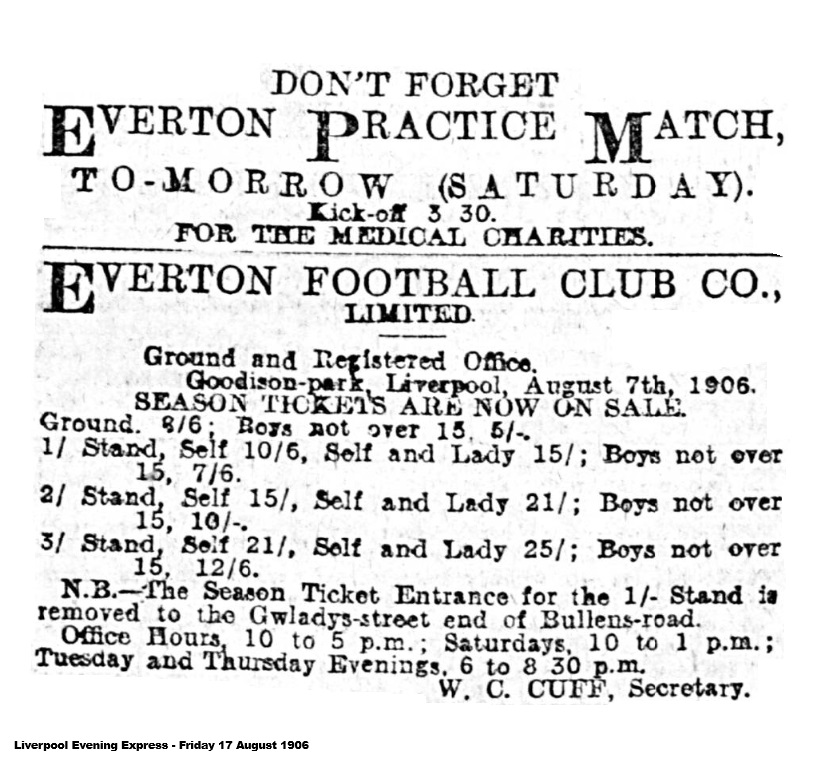
THE FOOTBALL SEASON
Liverpool Evening Express - Friday 17 August 1906
PROSPECTS FOR EVERTON
THE NEW PLAYERS.
We are now on the threshold of another football season. So far from interest in the great game having fallen off, there is every indication that football fortunes will be followed in the coming months with all the keenness which has distinguished past seasons. Our two premier local teams enter the season of 1906-7 with unique distinctions. In Everton we have the English Cup holders, and in Liverpool the League champions, a dual honour which has previously fallen to no town in the country. It is hardly likely that the coming season will provide the sensations of the last; such a record as this must be rare. Rut both clubs are fitted to take their part among the best in the great campaign, and hosts of enthusiasts will look to them to worthily
MAINTAIN PAST TRADITIONS of our local football history. Everton will enter the field with the confidence gained by rare consistency, and equipped in a fashion to sustain their reputation. Mr. William C. Cuff, one of the best of football secretaries, will have the comforting consciousness of finding in his list of players an uncommonly strong contingent. All the best of last season's men are retained, and the new ones are of demonstrated worth. Last season there were a number of players of the highly experimental sort, and some of them failed to justify the expectations formed of them. This season's recruits are approved and capable players of undoubted class. There are thirty men in the list, and as will be seen from the following names the habitues of Goodison-park need have no fear of coming events.
The goalkeepers are Scott, Depledge, and Sloan. The first-named needs no introduction, while Depledge will be remembered as the Wallasey player who was last season an amateur but is now a professional. Donald Sloan is
A NEW ACQUISITION, secured from Belfast Distillery. At back we have the two Balmers, Crelly, Hill, Stevenson, and Strettle. The two last-named are newcomers. W. Stevenson is a young player from Accrington Stanley, while Strettle is a Lively Polly man; both are sturdily-built, strong players, who are fully expected to prove capable understudies. In connection with Strettle, by the way, the Everton club were fined £2 under a rule whose wording hardly justifies the penalty. Football secretaries may gather from the decision that the rule (No. 37) implies that not only when an amateur is approached, but when the amateur approaches, his club must be informed. The half-backs are as before, Makepeace, Taylor, Abbott, Booth, Black, Chadwick,Donaldson,and Wright.
Forward we have last season's men, Sharp, Bolton, Young, Settle, Hardman, Donnachie, Cooke, Jones, and Butler, with four new players, R. Graham, George Wilson. David Wilson, and W. Dorward. Graham is an inside right from 3d Lanark. The two Wilsons, who are brothers, are regarded with
PARTICULAR FAVOUR. George Wilson played outside left for Scotland against England last season, while David is an inside left. Dorward is a centre forward from Montrose. This completes a list of players regarded by competent judges as worthy of wearing the colours of the Everton club. Jock Taylor will captain the League team with Sharp as sub-captain, the combination team being led by Black with Chadwick as deputy.
The players have been in training since yesterday week. All are in good health, and by the time the glorious 1st arrives they will be thoroughly fit for the season's work. It is earnestly to be hoped that the club will have better luck this time in respect of injuries. This matter was a serious handicap to Everton last season; and had much to do with the comparatively low position they occupied in the League table. The first practice match will be played to-morrow afternoon, the kick-off being timed for 3 30. The prices have been raised very slightly in the interests of the charities, which will benefit from the proceeds. The only notable absentees from the match will be Sharp and Makepeace, who will be on the cricket field. The ground is in perfect order. The recent rain has freshened up the turf, which now has
A SPLENDID APPEARANCE, the whole ground making a picture to gladden the eyes of devotees of the game. The English Cup is kept on the premises safely deposited under lock and key, in fact, under several locks and keys. It may be interesting to mention in passing that the ball used on that never-to-be-forgotten day at the Crystal Palace is still in possession of Rutherford. The Newcastle United player refuses stubbornly to give it up. There is hope yet that Taylor will enjoy his rightful privilege, and when Everton go north next month another effort will be made to get possession of the historic leather. The match with Newcastle is one of a heavy series with which Everton open the season. They play no fewer than 22 matches out of the programme of 38 League games in the first half of the season. This will give the club a chance of establishing itself firmly in the League table before the Cup-ties come on.
A word should be said about the season tickets. Shareholders and all applicants for tickets are earnestly requested to make their wishes known at once. It is extremely in- Convenient to deal with a glut of applications which often accompanies the practice matches and the opening League games. For the convenience of all parties, Mr. Cuff is in attendance at the offices on Tuesdays and Thursdays from 6 o'clock to 8 30, and shareholders are requested to make early application during these hours.
TO-MORROW'S PRACTICE MATOH
The teams for to-morrow's practice match at Goodison-park will be:—
Blues: Scott, goal; W. Balmer and Crelly, backs; Booth, Taylor, and Abbott,half-backs; Jones, Graham, Dorward, B. Wilson, and. G. Wilson, forwards.
Stripes: Sloan, goal; Hill and Stevenson, backs; Black, Chadwick, and Donaldson, half-backs; Donnachie, Bolton, Young, Settle, and Hardman, forwards.
The announcement that the Everton footballers are to-morrow having a practice game serves to remind us that the end of the Cricket season is in sight. Secretaries of clubs will as usual oblige by forwarding us their lists of averages so soon as their engagements are concluded.

WILLIAM OWEN
Wellington Journal - Saturday 18 August 1906
On Saturday morning William Owen, formerly a well-known half-back in the Wolverhampton Wanderers team, died at the Three Crowns Inn, Little Park Street, Wolverhampton, of which he was the landlord.
EVERTON’S PRACTICE MATCH
Liverpool Echo - Saturday 18 August 1906
BLUES v. STRIPES
Everton as usual at this time, gave an exhibition game at Goodison Park this afternoon, a small charge for admission being made, the proceeds going to the local charities. The gates were opened about three o’clock, and the crowds began to gather in their thousands. Before the start at half past three o’clock about 15,000 spectators had assembled. The teams faced as follow;-
Blues.- Scott; W. Balmer and Crelly; Booth, Taylor (captain), and Abbott; Jones, Graham, Dorwood, W. Wilson, G. Wilson.
Stripes.- Sloan; Hill and Stevenson; Black (Captain), Chadwick, and Donaldson; Hardman, Hudson, Settle, Young, Bolton, and Donnachie.
It will be observed from the above that the Blues had the league defence and the Stripes the league forwards. When the Stripes kicked off all eyes were centred on the new recruits, D and G. Wilson, but for the first few minutes the Stripes did most of the pressing, but Scott had no difficulty in saving his charge. Then the Blues got going, good work being done by the Brothers Wilson and Jones from the right sent in a splendid shot, which was cleverly got rid of by Sloan.
EVERTON FOOTBALL CLUB
Athletic News - Monday 20 August 1906
The Directors are prepared to receive applications for trials. Applicants must post full particulars as to age, height, weight, position and last club, to W.C. Cuff, Goodison Park.
PRACTICE AT GOODISON.
Athletic News - Monday 20 August 1906
By Junius
Everton have every reason to be satisfied with their first practice game. They were favoured with fine weather, they had a big crowd, and the play was of a promising character. Over 20,000 people were present, and the charities selected, the Hospital Saturday Fund and Stanley Hospital, will benefit to the extent of 126 pounds. The antagonists were the Blues and Stripes, the former representing the League defence, and the latter the League attack. Two prominent figures absent were jack Sharp and Harry Makepeace, whose services have been placed at the disposal of the County cricket club by the Everton directors until the end of the month. At the interval each side had a goal and the league attack won by three goals to two. The chief interest was naturally in the new men, and of these George Wilson the Scots International and Donald Sloan, the new goalkeeper secured from the Distillery, caught the eye, the former for some splendid centres, and the latter for a series of brilliant saves. The old hands showed no falling off, and Scott was equally safe as his countryman in goal. It was pleasing to note that Tom Booth, who was kept idea last season through injury and illness, displayed his old time virility.
EVERTON
20 August, 1906 - The Athletic News
By Junius
Everton-or, as they must be now termed by their less familiar title, the cupholders –have quickly, but none the less effectively, attempted to strengthen their forces during the close season. As in previous years, the players with whom they have dispensed were connected with their reserve eleven, and include Collins, Wildman, Oliver, Quinn, Birnie, Grundy, Hannan, and McLaughlin. Of this number, Wildman was by far the most promising player, and had Everton not been blessed with such a surfeit of useful full-backs, it is hardly likely that they would have allowed this local lad to leave.
Mr. W. Cuff, the courteous and obliging secretary, commence his fifth year of office under most favourable auspices, for his club is the absolute owner of the spacious and well-equipped Goodison enclosure, over which the English cup now sheds its lustrous glamour. The turf, as usual, is in perfect condition –indeed it is scarcely ever otherwise – and few alterations have been necessary on the ground, or staff connected therewith. Season tickets have been considerably reduced, and an innovation has been introduced by issuing them to boys, at an appreciable rate. The old players retained are Abbott, the brothers Balmers, Booth, Butler, Bolton, Black, Chadwick, Crelley, Cook, Donaldson, Donnachie, Depledge, Hill, Jones, Makepeace, Settle, Sharp, Scott, Sloan, Taylor, Wright, and Young, while Harold Hardman will also be again available. It will be noted that this list, given in alphabetical order, includes all last season's first team players and the most promising reserves. The new comers are D. Dorward, 5ft 8 ¼ ins, 10st10lb, age 20, who hails from Montrose; R. Graham, 5ft 7ins, 10st 4lbs, age 24, previous club Third Lanark; W. Stevenson, 5ft 8 ¾ in, 11st, age 21 from Accrington Stanley; S. Strettle, 5ft 11 ¾in, 11st 6lbs, age 20, from a local club; and the brothers D. Wilson, 5ft 8ins, 12st 4lb, age 24, and G. Wilson 5ft 6 ¼ ins, 12st 7lbs, age 22, who were obtained from the Hearts of Midlothian. At the meeting of shareholders a change in the directorate was made, Mr. R. Wilson, being elected, but the chairmanship will once more be in the highly capable hands of Mr. George Mahon, than whom no man has rendered greater service to the Everton club. Thus the cup-holders –I will accustom myself to this designation –will enter upon their new campaign with confidence and with such a strong coterie of sound and experienced players, who may be leavened with lever reserves when occasion demands, they should retain their position as one of the foremost and wealthiest clubs in the country.
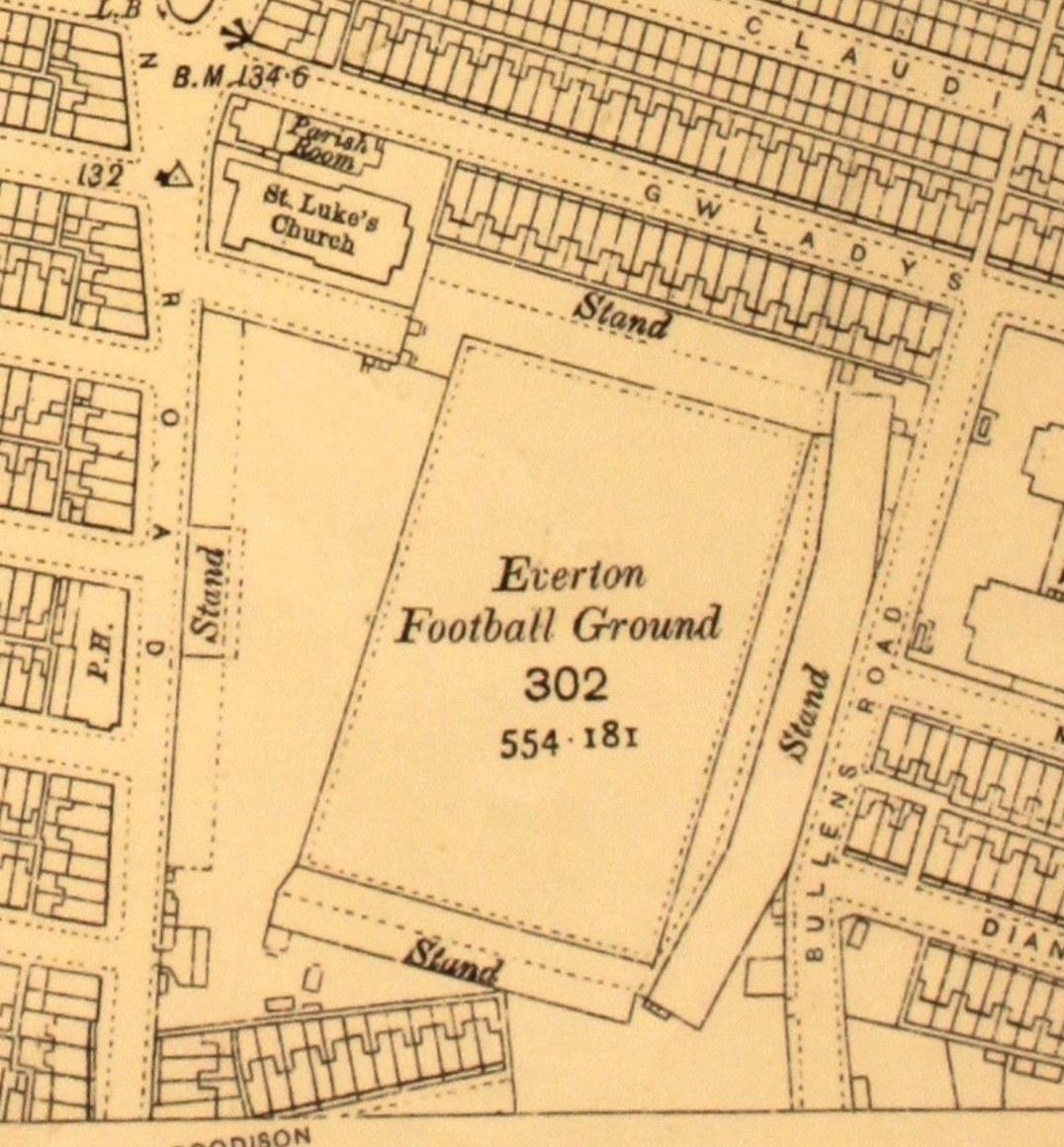
EVERTON PRACTICE MATCH
August 20, 1906. The Liverpool Daily Post and Mercury
Blues v. Stripes
Following their usual custom prior to the opening of the football campaign Everton gave an exhibition game at Goodison Park on Saturday afternoon, and as there was a small charge for admission the local medical charities to whom the proceeds are to be given, should benefit to a considerable extent. The gates were opened about three o'clock, and the crowd began to gather in their thousands. Before the start at half-past three o'clock about 15,000 spectators has assembled.
The teams faced as follow;- Blues, Scott, goal; W. Balmer and Crelly, backs; Booth (captain), Taylor and Abbott, half-backs; Jones, Graham, Dorward, D. Wilson and G. Wilson, forwards. Stripes; Sloan, goal; Hill and Stevenson, backs; Black, Chadwick and Donaldson, half-backs; Hardman, Settle, Young, Bolton, and Donnachie, forwards. It will be observed from the above that the Blues had the league defence and the Stripes the League forwards. When the Stripes kicked off all eyes were centred on the new recruits D and G. Wilson, but for the first few minutes the Stripes monopolized the game, and they had no chance. Scott was tested several times, but had no difficulty in saving his charge. Then the Blues got going, good work being done by the brothers Wilson, and Jones from the right sent in a splendid shot, which was cleverly got rid of by Sloan. After this the game in favour of the Stripes and the Blues defence was at times sorely tried. After some clever forward work Settle had the goal at his mercy from a clever pass by Hardman but sent the ball high over the bar. A rush to the other end by the Blues gave G. Wilson an opening and he sent in a terrific shot, but Sloan saved magnificently, and was deservedly cheered. Hardman next had a chance of opening the Stripes account, but after passing the backs and had nothing to beat but the goalkeeper he missed by about a couple of feet. The Blues retaliated and from a well-judged centre by G. Wilson, Graham headed the ball past Sloan amidst loud cheers and thus drew first blood for the Blues. The Stripes got away from the kick-off and from Bolton's pass Young should have scored but again missed the mark. The Stripes goal had a narrow escape from a shot by Jones the leather just shaving the post. A run up by Donnachie took him past all opposition but he finished up by shooting into Scott's hands. After Young had again failed Settle got hold and with a grand shot beat Scott completely and thus equalized the score. The crowd had increased to about 20,000 when the game was resumed. The Blues were the first to get dangerous and D. Wilson made a grand attempt to increase the score, but Sloan saved cleverly. The Stripes then dashed away Hardman putting across to Donnachie who defeated Scott with a lighting shot and thus gave his side the lead. The Blues by some really clever play swarmed round the Stripes goal and with Sloan on the floor a goal looked certain but the latter managed to tip the ball over the line. For some time after this the Blues kept pegging away at the Stripes goal, the brother Wilson having hard lines with some grand shots. A sudden break away by the Stripes ended in Settle putting on a third goal, Scott having no chance. The Blues were soon afterwards at the other end, and after some near things Dorward at length found the net. The Blues had decidedly the best of this half but were unlucky. Result Stripes 3, goals, Blues 2.
Taking the play all round it was a very interesting game both sets of forwards showing good form, and the brother Wilson have established themselves as prime favourities by the spectators, especially G. Wilson, whose fine centres and shots at goal were a treat to see. The backs and half-backs also gave a good display, and the goalkeeping of Scott and Sloan was beyond praise.
EVERTON'S FIRST TURN OUT .
August 20, 1906. The Liverpool Courier
Upwards of 20,000 spectators witnessed Everton's first practice match at Goodison-park on Saturday, under ideal conditions. The teams –Blues v. Stripes –comprised the recognised League defence and practically last season's League attack respectively, and there was a lively speculation as to how the “trial” men would acquit themselves. The Blues were respesented by Scott, goal, W.Balmer, and Crelly backs Booth, Taylor (Captain), and Abbott, half-back, Jones, Graham, Dorward, D.Wilson, and G.Wilson, forwards. Stripes: - Sloan, goal, Hill, and Stevenson, backs, Platts, Chadwick, and Donaldson, half-backs Donnachie, Bolton, Young, Settle, and Hardman, forwards. Referee Mr.J.F.Langford , Waterloo, was referee. The game opened somewhat tamely at first, but ere long the Stripes settled down to serious business and Scott had to put in some of his smartest work to save from Donaldson. This livened things up a bit, and put the Blues on their metal. It was now that some of the new blood showed their paces, G.Wilson displaying both speed and resourcefulness, while Jones on the right wing was more than once applauded for some clever footwork. After Sloan had saved in rather neat fashion from Dorward, the Stripes made a determined onslaught on the opposing citadel, and Settle twice unsuccessfully essayed a shot. The Blues retaliated briskly, and at length were rewarded, Jones centring right across to George Wilson, who returned the ball right into the goalmouth, Graham making no mistake about scoring. Each end became the scene of some fast play, and Sloan on one occasion only saved by a really splendid clearance. Just on half time, however, Settle made up for his ill-luck earlier on by notching the equalising point for the stripes. There were some spirited play on resuming, and a regular rasping shot were put in by D.Wilson, but to no purpose, as it was negotiated in a masterly way by Sloan. A minute later, however, the ball was rushed to the other end, and Donnachie put the Stripes ahead with a good shot. The Blues tried hard to even up matters, G.Wilson especially putting in some dangerous centres, but despite these efforts Settle managed to take advantage of an opening, and put on a third goal for the League attack. A few minutes before the time was called Dorward added a goal for the Blues, the final score thus standing Stripes 3 goals, Blues 2 goals. On the whole the game afforded ample opportunity for the individual players to shine. G.Wilson was constantly prominent for both judgement and skill, and will yet do yeoman service for his side. Sloan shaped splendidly in goal, and although any ugly rushes did not test him, he certainly created a most favourable impression. Graham and T. Jones were also prominent by some good all round work. The proceeds, which go to charity, realised £150.
EVERTON’S FIRST TURN OUT
Liverpool Evening Express - Monday 20 August 1906
Upwards of 20,000 spectators witnessed Everton's first practice match at Goodison-park on Saturday, under ideal conditions. The teams—Blues v. Stripes—comprised the recognised League defence and practically last season's League attack respectively, and there was a lively speculation as to how the "trial" men would acquit themselves. The Blues were represented by Scott; W. Balmer and Crelley; Booth, Taylor (Captain), and Abbott; Jones, Graham, Dorward, D. Wilson, and G. Wilson. Stripes—Sloan; Hill and Stevenson; Platt, Chadwick, and Donaldson; Donnachie, Bolton Young, Settle, and Hardman. Mr. J. F. Langford, Waterloo, was referee.
The final score read—Stripes 3 goals; Blues, 2 goals.
On the whole the game afforded ample opportunity for the individual players to shine. G. Wilson was constantly prominent for both judgment and skill, and, will yet do yeoman service for his side. Sloan shaped splendidly in goal, and although he was not tested by any ugly rushes, he certainly created a most favourable impression. Graham and T. Jones were also prominent by some good all round work. The proceeds, which go to charity, realised £150.
EVERTON F.C PROSPECTS
Liverpool Echo - Monday 20 August 1906
WORDS ON THE COMING SEASON
We are within less than a fortnight of the opening of the football season for 1906-7, and the question now naturally arises among supporters of our two local organisations; What are the relative prospects of Liverpool and Everton? This is the question with which I propose to deal, taking each club separately. The present occasion I shall devote to the Cupholders. We shall hear that term often during the ensuing season, and let us hope, if it is not looking too far ahead, the season following. When the Blues step on the field for the first time in League warfare, they will have good reason to be proud of themselves. However, they must not for a moment imagine that it will be a bed of roses. If they intend to again secure honours they will not have to slacken one iota from last season. Of course, Everton, we know, have a happy way of rising to the occasion, but, if I may use a well-worn, but nevertheless true, adage, “There’s many a slip,” &c. They will be doing themselves a service if they keep this before them during this strenuous campaign. My reason must not credit me with being pessimistic, nor am I trying to find fault. Yet, on the other hand, I would say, “Don’t get optimistic,” or, at any rate, not to an extreme. We have the same team that won the Cup, and many think, I know, what the same men have done once they can do again. Admitted, on one condition, which is, as I have already stated above, that the players must not established both collectively and individually a feeling of over-confidence. To my mind, this rather doubtful quantity is synonymous with humiliation. Everton have a strong team. I will go further, they are as good as any in the League, and, therefore, capable of holding their own. In fact they have such a number of clever men on the reserve list that even when the regular men are kept out by injuries (they had plenty of them last season) the vacancies will be well filled. By this I do not mean that the absence of Hardman, Sharp, Taylor, and others would not be felt.
I was at the practice match on Saturday last, and was much impressed by the exhibition of the reserve men. Not particularly so by at least two new one. Harold Hardman will not have to strive hard to keep his place from G. Wilson, and neither will Settle to keep out the latter’s brother David. These men are from heart of Midlothian, it will doubtless be remembered. Not for a moment do I believe they will prove white elephants. It is not always advisable to judge on first appearances. They are well-built, sturdy fellows, and it is to be sincerely hoped they will sustain the reputation which they bring to Goodison Park. Now I have mentioned this pair I will deal with the regular “Blues.” Barring accidents it is quite probable that Scott, W. Balmer, Crelly, Makepeace, Taylor, Abbott, Sharp, Bolton, Young, Settle, and Hardman will open the season. The first named will keep as good a goal in the future as he has done in the past, and in front of him will be the usual reliable and powerful kickers W. Balmer, and perhaps I ought not to omit R. Balmer, and Crelly. Between them and the opposing forwards is that thin blue line Makepeace, Taylor, and Abbott.
By the way, when I say “thin” I don’t mean to cast a reflection on the player’s bodily appearance. Walter Abbott is looking very well, and right-wingers will find him as watchful as ever. The old warhorse is now the captain, and right well does he deserve it. I offer him congratulations, and also those of his many admirers, on his attaining this distinction. Harry Makepeace I have seen several times this summer, and have frequently travelled in the same train to Old Trafford. For Makepeace I have considerable admiration, both as a cricketer and footballer. Both he and Sharp are keeping fit. The latter and Bolton most certainly impress one as a wing, and possibly will be seen to even better advantage than hitherto. Young I am glad to say, has apparently improved in health. He is one of the best pivots playing to-day when at his best. He must open out the game with long, swinging passes, but eschew the habit of facing his own goal and bringing the ball back. Hardman and Settle from what I have already seen, understand each other to a nicety- a necessary qualification for partners. Tom Booth seems to have lost his place, notwithstanding which he will probably be seen at intervals.
In Sloan, although I have not seen him play often, the committee have, I venture to state, a capable understudy to Scott. The second string should be strong in defence with Hill and Stevenson. Hill impresses one as a coming back, and a similar term might be applied to Stevenson. Add to these a capable trio in Black, Donaldson, and Chadwick, together with Jones, the brothers Wilson, Graham, Donnachie, and Dorward, the directors have little cause for alarm and plenty of room for congratulation. They are fortunate in having en bloc the cup team, with a number of good footballers to fall back on in an emergency. Under such circumstances there is every reason to suppose the Evertonians look forward to a successful season, both from a financial and playing point of view. -RANIUS
VIEW OF THE COMPLETED DOCK BOARD OFFICES
Liverpool Daily Post - Monday 20 August 1906
This magnificent structure is now all but complete-that is, as viewed from the outside. Four-fifths of the exterior scaffolding has gone, and what remains is only to facilitate the cleaning of the face of the stonework which has become soiled in the process of building. When this comparatively unimportant detail is finished, the rest of the scaffolding will be removed, and the beautiful pile will look spick and span. A few weeks hence the aspect of the building will be similar to the sketch made by our artist, Mr. Louis Weirter. Much remains to be done in the interior before the new offices will be ready for occupation. The contract time expires on the 1st of March next, but the builders are confident that should the Dock Board desire the building could be ready for their reception at the end of the present year. Three years next month (September) operations were commenced. The old dock was thirty-one feet deep from the surface of the street, and delving for bed rock was the first consideration. On the east side the rock was found two feet below the bottom of the old dock; but on the west side the workman had to go down eighteen feet for it, making thirty-three feet of depth of foundations on the east side, and forty-nine feet on the west side. On the rock concrete pillars and archways were constructed, and on these the huge building rests. So thoroughly and surely was this initial work done that up to date there has not been a single “settlement” in any portion of the building-a truly marvellous circumstance in a structure of its dimensions. The first stone was laid by Mr. Briggs, one of the architects, on January 20, 1904. The contract price for the structure was £227,000, but the full cost will probably reach £300,000, with the addition of approximately, £20,000 for furnishing.
A full description of this stately building has already appeared in these columns. We will now recount a few only of the general but salient features. The style is Rennasissance freely treated; length 264ft., width 216ft., height (main building) 85ft 6in; the great dome is 223ft high and compared with other domes in the British Isles is second only in altitude to that of St. Paul’s Cathedral. Most of the building is constructed of Portland stone, but the lower portion is on granite hewed from the Dock Board’s own quarry at Kirkmabreck, in the North of Scotland. On the west front-that is, facing the river, is the main entrance, on the sides of which will be two sculptured figures representing Commerce and Industry. The business entrances are at the north and at the south-east corners. Through the east octagonal tower the rates and dues office is reached. This room stretches the entire length of the building. In the basement are the storerooms; on the ground-floor the treasure’s office, rates and dues office, and other offices; on the first floor, statistical department and general office; second floor, the boardroom, manager’s, solicitor’s, and other offices’ third floor, members’ dining-room and departmental offices; fourth floor, clerk’s dining-room (which stretches half the length of the building), kitchen, &c.; above are the keeper’s quarters. The sanitary arrangements are so constructed as to be completely closed off from the main building.
The boardroom will be a handsome apartment. It is to be adorned with mahogany framing and sixteen fluted pilaster columns, also of mahogany. The ceiling is tubular, and richly ornamented. The floor is of oak.
Beyond question the main feature is the great dome, whence corridors and passages radiate to all parts of the building. It was this special point which decided the adjudicators in favour of the design as against all others submitted. At the base the dome is 74ft in diameter, and the expansive space from floor to cupola is delightfully impressive. From the galleries of the dome every department in the building can also be reached. The embellishment consists of stucco work at the top, marble dado, and Tarraza imitation marble floor. The dado and floor will cost about £15,000.
The area of the whole building is enclosed by a granite boundary wall with turned balustrades, the stone for which has also been brought from the board’s granite quarries at Kirkmabreck. Proofs of Mr. Weiter’s sketch on art paper may be obtained after Wednesday next at the “Daily Post and Mercury” offices, Victoria-street. Prices 6d; by post 7d.
EVERTON F.C.’S PRACTICE MATCH
Liverpool Echo - Monday 20 August 1906
Football is at hand. This is a fact which was quite evident at Goodison Park on Saturday. The directors this time made a charge of 2d admission, and local charities should benefit to a great extent. There were two pleasing features of the game. Firstly, it was played in no half-hearted fashion, but with all seriousness; secondly, there was not a striking injury to any of the players. The sides were on the usual plan of first team defence against first team attack, and some excellent football was seen. The former (Blues) were beaten by the odd goal in three, but a better reflex of the game would have been a draw. In an even first half, each side scored, but the Blues hardly took advantage of their chances, several splendid centres from Jones going begging. Neither Sloan nor Scott was kept really busy, but each dealt with what shots came their way cleverly. Scott could not be blamed for the shots that beat him in the second half. The Blues had considerably the better of the play after the interval, but Young, and his forwards shot when opportunity afforded. The first team forwards played a good, clean passing game. Settle and Hardman were the best. Young, in the centre, kept his wings going, although Donnachie might have been fed a little more. They received excellent support from Chadwick, Donaldson, and Black. The latter worked hard, and quite overshadowed the Wilsons. Hill and Stevenson presented a strong defence, but they were not opposed by a very strong forward line, which does not, however, detract from their performance. Stevenson, the new man, clears cleanly, and, with experience, he will come on. Sloan seems to have a tendency for falling to Mother Earth too often in saving low shots.
For the losers, Scott kept a good goal. The backs, W. Balmer and Crelly, had plenty to do, and will be able to testify as to the qualities of their clubmates. Hardman and Settle, the latter of whom scored a couple of goals, kept Balmer pretty busy. Booth played a sterling game, while on the opposite wing Abbott almost aways held Bolton and Donnachie. Of the Blues’ forwards Jones was the star. He made a number of clever runs along the touch-line, but his centres were not turned to advantage. He did not received much support from Graham. Dorward did not keep his wings going sufficiently, and the brothers Wilson will probably be seen to better advantage with more experience of their clubmates.

McLAUGHLIN IS GOOD.
Football Chat and Athletic World-Tuesday August 21 1906
McLaughlin, the old Everton forward, ought to do valuable attacking work for Plymouth Argyle. More than once he has shone in the best company, and I expect him to get a regular place in the new Argyle side,
EVERTON CLUB PRACTICE MATCH.
Liverpool Evening Express - Thursday 23 August 1906
The final practice game is to be played at Goodison-park on Monday evening text, commencing at six o'clock. Prices for admission will be as before—Adults, 2d.; boys, 1d.; stand, 3d.; and the proceeds will be devoted to the Hospital Saturday Fund and the Stanley Hospital. Mr. W. Cuff, the club secretary, will be at the office on Tuesday and Thursday evening until 830 for the convenience of purchasers of season tickets, and the hope is express that the purchase of these, tickets will not be delayed until the match days.
EVERTON CLUB PRACTICE MATCH.
Liverpool Evening Express - Friday 24 August 1906
The final practice game is to be played at Goodison-park on Monday evening next, commencing at six o'clock. Prices for admission will be as before—Adults, 2d.; boys, Id.; stand, 3d.; and the proceeds will be devoted to the Hospital Saturday Fund and the Stanley Hospital.
Everton’s second practice match will be played at Goodison-park on Monday next., Kick-off six o’clock.
Blues.- Scott, goal; Balmer and Crelly, backs; Makepeace, Taylor, and Abbott, half-backs; Sharp, Bolton, Young, Settle, and Hardman, forwards.
Stripes.- Sloan, goal; Hill and Stevenson, backs; Black, Chadwick, and Donaldson, half-backs; Donnachie, Graham, Jones, Wilson, and Wilson, forwards.
FOOTBALL FEATURES
Liverpool Echo - Friday 24 August 1906
Everton’s second and last practice match will take place on Monday next at Goodison Park, the kick-off being timed for six o’clock. The teams are as follow;- Blue; Scott; W. Balmer and Crelly; Makepeace, Taylor, and Abbott; Sharp, Bolton, Young. Settle, H.P. Hardman. Stripes.- Sloan; Hill and Stevenson; Black, Chadwick, and Donaldson; Donnachie, Graham, Jones, D. Wilson, and G. Wilson.
It will be noticed that the players on the side of the Blues are all last season’s Cup team.
TRANMERE ROVERS
Birkenhead News - Saturday 25 August 1906
As has already been stated in these columns, the club has been subsidised by the Everton Club, and will assist in training those Everton players who are from time to time not called upon to play in the Everton teams. No doubt the league club’s officials will keep a strict look out for other budding local players, and those players who have the ability and who are anxious to rise in the football firmament will find equal opportunities of advancement as those players who from time to time will come over from Everton. That the Rovers have been the selected club to assist our great league organisation in discovering high-class players is a compliment to the Wirral district, and one which will doubtless be appreciated by the Rovers’ numerous patrons who have stood loyally by our oldest club during the past 25 years.
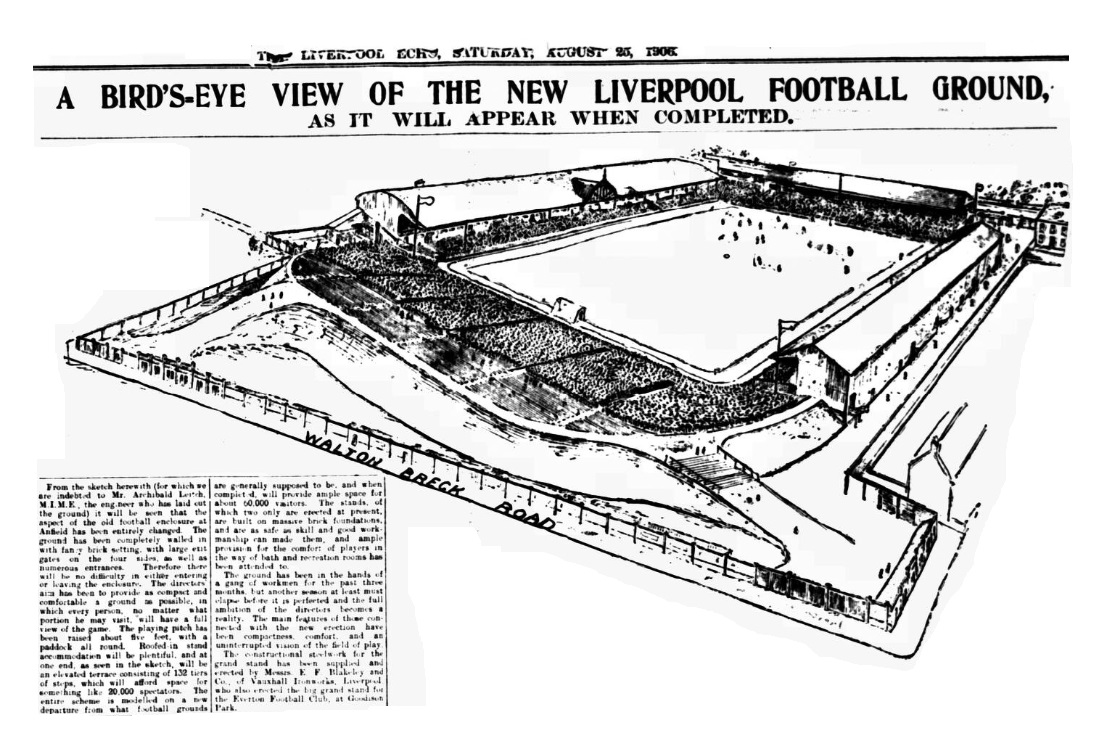
NEW TOWER BUILDINGS, LIVERPOOL
Liverpool Daily Post and Mercury- Monday 27 August 1906
Tower Buildings at the bottom of Water-street, are soon to disappear, and an imposing structure, the elevation of which is shown by the above sketch, to be erected on the site. It is not unusual to speak of “Old” Tower Buildings, the qualifying adjective having in reality reference to the fact that the old Tower of Liverpool stood on the spot for some generations up to 1819 than to the age of the present buildings. As a matter of fact, Tower Buildings, a hive of commercial activity, is but half a century old. Their construction is out of date; there are awkward staircases and no hydraulic lifts. The latter are indispensable concomitants to modern offices of any size, and consequently Baron Glanusk, who has succeeded to the estate, determined upon the erection of the new building, which is to embody every improvement and facility modern offices demand. The old building has always been of special interest because it indicated a historic landmark-to wit, the Old Tower, a model of which Professor Ramsay Muir suggests should be made as one item in the celebration of the 700th anniversary of King John Charter. It has another significance to the local antiquary; it stands on part, at ant rate, of the site of the Slave Market. With the erection of the new building and the street improvement-widening of Water-street-which forms one item in the scheme, Prison Weint will be obliterated, and with it will disappear the last evidence of the taint of the slave trade carried on about the beginning of last century in the town.
Sir James Picton, in his “Memorials,” says the site of Tower Building during the early years of the nineteenth century was occupied with a grim-looking, castellated structure, the “Tower” of Liverpool, which in the olden times was the fortalice of the Earls of Derby; indeed, its history is closely connected with the fortunes of the Stanleys of Knowsley. For many years it was the seaside residence and embarkation place for the Isle of Man and Ireland of the Derby family. During its later years the ancient structure was used as a common gaol, and notwithstanding the erection of the New Borough Goal in 1786, the old Tower continued to be occupied both by felons and debtors down to July, 1811. It then remained unoccupied until 1819, when the building was pulled down for necessary improvements in Water-street, and the materials sold by auction for £200. During the sailor’s riots in August, 1775, some of the rioters were secured and ledged in the old Tower. A mob of about 2,000 men assembled and attacked the gaol, which surrendered at discretion, and the prisoners were carried off in triumph. At one period balls and assembles were held in the ancient chapel of the Tower.
An idea of the size of the new building may be gleaned from comparison with the old. Tower-buildings, as they now exist, are 136 feet high, that is to the top of the tower. The new building, which will retain the old name, and in this sense perpetuate tradition, will rise up eight storeys and have a main central tower with an altitude of 152 feet. Its office area will amount to 11,800 square yards, compared with 5,400 square-yards in the existing building. There will be three public entrances-from Water-street, the Strand, and from the Church-yard-and inside the building there are to the three main staircases and four lifts. Architecturally, the new building will be massive and imposing; but as utility is the main feature of the design, rent and lights have naturally been the chief objects, seeing that the building is exclusively devoted to commerce. The various tenants will vacate their offices at the end of the present year, and the new building is expected to be ready for occupation in 1908. The site of the new structure will cover about half an acre of land. The whole of the ground floor is to be occupied by the Booth Line, and will rank as one of the largest single offices in the city; half of the first floor will be taken by the Ellerman and Hall Lines, and Messrs F.H. Powell and Co will have a suite of offices on the second floor.
The architect for the new building is Mr. W. Aubrey Thomas, State Insurance-buildings, Dale-street.
BEE’S NOTEBOOK RESUMED
Liverpool Echo - Monday 27 August 1906
Well, friends we shall soon be in the thick of it. It signifies the opening of the season. Then the cries will be “Play up the Reds!” and “Play up the Blues!”
Glorious Football! The first man I met in Liverpool was Mr. W.C. Cuff; next I came across Harry Makepeace, who made hay while the sun shone. Lancashire having finished off Derbyshire in two days, the half back took the odd day not to loll about, or indulge a parcels of what Mr. Richard Swiveller, to the “Old Curiosity Shop,” calls “rosy wine.”
The Everton turf looked as trim as ever, and I learnt that the Wilsons, George in particular, have done all that was expected of them and promised to be of decided value to the Blues. The ex-Hearts and international has quickly made himself a favourite with the crowd, and has had thrust upon himself the popular name of “Smiler.”
Had the crowd had a view of Makepeace, Bee, and “the assistant secretary” they might have christened me not “Smiler” but “Rotter.” I can vouch for the retained power of Makepeace in the matter of penalty kicks will not need much training after the preliminary trial to-night. Still it is always wise that a man indulged in ball-booting in earnest, for the muscles at the ankle are most tightened up after three months’ rest, and I care not who he may be, a footballer after an absence of a month or more from the playing area will find on resuming that his ankle muscles are tender and aching within’ twenty-four hours of his having touched the ball.
EVERTON PRACTICE MATCH
August 28 1906. The Liverpool Courier.
The second of the practice matches arranged as a preliminary to the opening of Everton's League campaign took place last night at Goodison-park in the presence of about 10,000 spectators, the proceeds again being devoted to charitable objects. An eleven representing the League team (Blue) opposed a team composed of the reserves (Stripes), and the game started at six o'clock in very favourable weather. Teams: - Blues: - Scott, goal, W.Balmer and Crelly backs, Makepeace, Taylor (Captain), and Abbott half-backs, Donnachie, Bolton, Young, Settle, and Hardman forwards. Stripes: - Sloan, goal, Hill, and Stevenson, backs Black, Chadwick, and Donaldson, half-backs, Jones, Graham, Dorward, D.Wilson and G.Wilson, forwards .
The game was productive of good play, and the spectators were much impressed with the way both teams acquitted themselves. No score came until half an hour from the start, when Settle scored for the Blues, after Sloan had just saved. Shortly afterwards Young sent in a good shot which took effect. Sloan seemed to be claiming for offside when the ball passed him. At the interval the Blues were leading by two goals to none. The second half found the Stripes in a more earnest mood, and they certainly proved themselves triers all over. Capital shots were rained in on Scott, whose abilities were thoroughly tested, Dorward, G.Wilson, and Jones aiming to good purpose. They certainly deserved better success. The League players were however, dangerous, and Young, in one of his dashing moves, increased the Blues' lead, and the final was 3-0 in their favour.
The quality of play displayed by the recruits was of a high order, especially that of G.Wilson and D Wilson. The former showed a fine turn of speed, and frequently evoked applause from the spectators whilst D.Wilson passed well. Jones, at outside right played a game, which had many good points. Sloan performed very cleverly in goal, and it is quite evident that in him Everton will be able to rely upon a useful acquisition in that department of the field. His style last night was cool and confident. As already indicated Scott proved his immense value, and the form of the League team as a whole was such as to inspire confidence.
EVERTON PRACTICE MATCH
Liverpool Daily Post and Mercury- Tuesday 28 August 1906
The second public practice game held prior to the commencement of the season proper was played at Goodison Park last evening, when a crowd of fully 8,000 spectators put in an appearance. As in previous cases the proceeds of the gate were to be devoted to local charities. The teams lined up as follow;-
Blues: - Scott, goal, W.Balmer and Crelly backs, Makepeace, Taylor (Captain), and Abbott half-backs, Donnachie, Bolton, Young, Settle, and Hardman forwards.
Stripes: - Sloan, goal, Hill, and Stevenson, backs Black (captain), Chadwick, and Donaldson, half-backs, Jones, Graham, Dorward, D.Wilson and G.Wilson, forwards.
It will be noted that the full League team opposed the reserve strength, which included the recruits. During the initial half the Blues had matters much their own way, and after twenty-seven minutes’ play Bolton put in a fine low shot, which Sloan fisted out but failed to clear properly. Settle fastened on to the sphere and had little difficulty in notching the initial point. Five minutes later Young added a second goal for the Leaguers, Sloan making no attempt to get at the leather, which sailed into the corner of the net while he appeared to be busy claiming for offside. The interval arrived with the Blues leading by 2 goals to nil.
The second half was more evenly contested and the Stripes claimed a fair portion of the play, but it was left to the Blues to again monopolise the scoring. Young doing the trick with a low shot from close range, Sloan having no possible chance of saving. The end came with the score standing; Blues 3 goals, Stripes nil.
The game providing an interesting contest and proved an excellent curtain-raiser for the season’s work. Of the League players it is only necessary to say that one and all gave ample evidence of fitness to undertake the more exacting work which will be inaugurated on Saturday next. The defence was sound in every detail, while the intermediate trio, without being brilliant, have occasional glimpses of their true form, which, when pitted against more formidable opponents, will, we are confident, not be found wanting. The forwards, without extending themselves to the utmost, showed excellent Combiantion. The right wing was particularly sprightly and it was pleasing to note the capital form of Young. His serving to his wings was always clean and well-timed, while he got in some clever shots. Sloan gave another masterly display of goalkeeping, some of his clearances being of a very high order, and he should prove a very capable understudy to Scott. In Hill and Stevenson the club have a capable pair of backs. A looseness was noticeable at times, which, however, may easily be remedied by experience and a more finished knowledge of each other’s play. Black was the more prominent of the halves, and got through an immense amount of sound work. The forward line was best represented by the brothers Wilson. G. Wilson was the more prominent, and he got in some useful and effective moves down the wing, while his crosses to the centre were generally true and well-timed. He gave Scott several warm handfuls to negotiate, and he was judiciously fed by his brother. The right wing failed to create such a good impression. Jones in the first half was starved, while his play generally suggested that he was out of his place. Graham’s work was not effective, no doubt owing to the inability of Jones to adapt himself to the extreme wing position. Dorward, we are inclined to think, is a diamond in the rough. He is always hovering about the goal ready to take up the centres, while his fearless and dashing tactics are well calculated to upset an ordinary pair of defenders. To sum up, Everton must be congratulated on having such a capable and efficient set of reserves.
EVERTON F.C. PRACTICE MATCH.
Liverpool Evening Express - Tuesday 28 August 1906
The second of the practice matches arranged as a preliminary to the opening of Everton's League campaign took place last night at Goodison-park, in the presence of about 10,000 spectators, the proceeds again being devoted to charitable objects. An eleven representing the League team (Blues) opposed a team composed of the reserve (Stripes), and the game started at six o'clock in very favourable weather-
Teams.—Blues: Scott, goal; W. Balmer and Crelly, backs; Makepeace, Taylor (captain), and Abbott, halves; Donachie, Bolton, Young, Settle, and Hardman, forwards.
Stripes: Sloan, goal; Hill and Stevenson, backs; Black (captain), Chadwick, and Donaldson, halves; Jones, Graham, Dorward, B. Wilson, and G. Wilson, forwards.
The game was productiveof good play, and the spectators were much impressed with the way both teams acquitted themselves. No score came until half an hour from the start, when Settle scored for the Blues after Sloan had just saved. Shortly afterwards Young sent in a good shot which took effect. Sloan seemed to be claiming for offside when the ball passed him. At the interval the Blues were leading by two goals to none. The second half found the Stripes in a more earnest mood, and they certainly proved themselves triers all over. Capital shots were rained in on Scott, whose abilities were thoroughly tested. Dorward, G. Wilson, and, Jones aiming to good purpose. They certainly deserved better success. The League players were, however, oftentimes dangerous, and Young, in one of his dashing moves, increased the Blues' lead, and the final was 3-0 in their favour. The quality of play displayed by the recruits was of a high order, especially that of G. Wilson and B. Wilson. The former showed a fine turn of speed, and frequently evoked applause from the spectators, whilst B. Wilson passed well. Jones, at outside right, played a game which had many good points. Sloan performed very cleverly in goal, and it is quite evident that in him Everton will be able to rely upon a useful acquisition in that department of the field. His style last night was cool and confident. As already indicated, Scott proved his immense value, and the form of the League team as a whole was such as to inspire confidence.
EVERTON’S PRELIMINARY SHOWS US SOME USEFUL MEMBERS
Liverpool Echo –Tuesday 28 August 1906
There were two curiosities before my notice yesterday. The first was that a colleague “Ranius” having failed to note my seal for work, actually added his comments on the Liverpool practice match to those I had sent to the office by post, and, unfortunately, by lapsus memorise he made Platt, who left the Reds for the South two months ago, the first team goalkeeper!
Everton’s practice match last night gave me a rather rooted impression that they were going to have a good season. The play in itself was not productive of a statement. “So-and-So was the best man on the field.” The fact was the whole of the members engaged were in capital form, and the directors this year have some reserve talent that will not fail them if in the time of need, through accident to first team players, when called into service. I was especially interested in the Wilsons. The general impression was that George is the better player. I liked David quite as well as his smiling brother. The pair work together with a brotherly love and understanding which is most appreciable and both have a wealth of football in them. The Everton disciples have hardly taken to the nick-name “Smiler” unanimously, for some of them call him “Gee,” which, of course, is consequent upon his likeness to the former Everton forward of that name. Gee has much weight to carry, and seems to possess an unusual amount of speed for a player of his weight. Each of the brothers worked in businesslike manner, and when they came to shooting-range there was power behind the effort. They send in ten-tonners. Makepeace, nevertheless, ably coped with his adversaries. All the Cup team played up to the Crystal Palace form; and how strange it was that their opponents were attired in the colours of the runners-up in the Cup competition-black and white stripes and white knickers. Harold Hardman, I believe, wrote a friend a week or so ago telling how slowly the summer was passing, and that he longed for football to commence. What a whipcord he is; full of life, as wiry and almost as thin as my fox-terrier, and just as deceiving. More than one friend has seen my pedigree animal, and various are the “insanitation’s.” against me. For instance, an Everton officer said, “Drink less; feed the dog more”: another, “That animal has got consumption in his hind-quarters’: another, “What is it- a rabbit?” Well, Harold Hardman is just as deceiving. He gives one the idea that he could not last one match through; yet he retains his stamins the whole season through and such requests as some professionals would make the absence from the field are never dreamed of by the outside left, who, with Farmer Settle, made a strong wing. Donnachie played in characteristic style-his is a deceiving style; he seems to do his work in a nonchalant spirt. That’s what one gathers from the surface of his play. In reality his football not always, of course, is made up of artistic touches and class football. Sloan was most to the fore. He is of great height, daring almost to a degree of dangerous and showing more of the Roose features than any other custodian I know of. Young, too, was in his brightest mood, and his long passes were irreproachable. A continuance of such form will be delightful, for the Scot at his best is most attractive, inasmuch as you can never gather what his twirl and sprint will be. His confrere, Dorward, made one exceptionally great dash through at express speed, and Hill demonstrated an improvement on former form, and with the latter you will agree there was nothing to cavil at. Stevenson was impetuous and nervous. We must wait a little longer ere we see his worth. Graham is a forward full of possibilities, and Jones the whole-hearted Prescot youth, makes a capable outside right. I think the Cup team will figure on Saturday against Middlesbrough, who held their second practice last night.
Two of the Goodison spectators came to blows. This is rather early in the season surely! Fortunately there are very few instances of this momentary loss of common-sense.
FOOTBALL CELEBRITIES
Football Chat and Athletic World- Tuesday August 28 1906
IN THE DAYS OF THEIR YOUTH
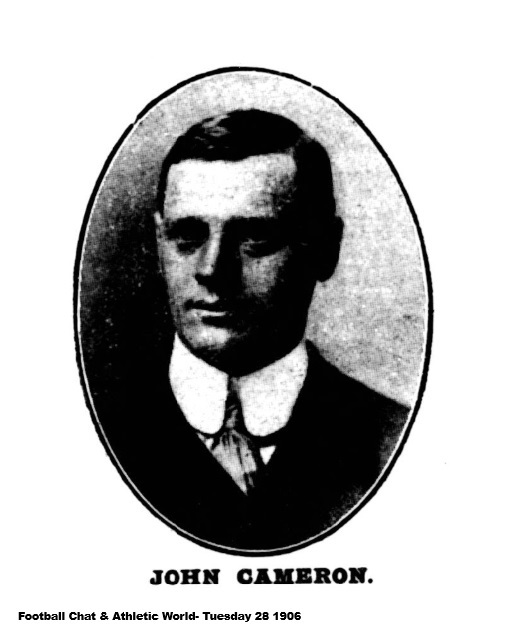
MR. JOHN CAMERON.
If there is one sentiment that links the man, for whom football and its management is a serious business, with the man whose calling lies in the more ordinary directions of life, it is the sentiment of harking back to the days when we were laddies. And it seems to me that the footballer, by the very nature of his work, preserves certain traits of the healthy-mindedness of youth which are apt to be rubbed out in the common round, where money-grabbing is the tole and whole object. However, I must not pitch philosophic platitudes at the editor's head, but tell him something of my joyous youth. When did I cease cutting my football teeth? Really I cannot tell. You see, the footballer is born, not made. And everybody is born a footballer. Doesn't the infant kick? But as the birthdays roll on, the instinct either dies—repressed by the stern control of refractory parents —or expands to the swift destruction and ruin of many a pair of boots. In my case, the instinct expanded. The pairs of boots that were demolished in my youthful efforts would, I suppose, have shod a family.
And yet, in one way of looking at it. I might be tolerably safe in declaring that I never had any football youth. For I was playing senior games at the age of fourteen. This was with Ayr Parkhouse, the club of my earliest affections. Centre-forward was generally my position, though they looked upon me as a sort of general utility man, and sometimes I defended citadel from half-back. How I came to be a football gladiator at that juvenile period was duo to circumstances over which, as the phrase goes. I had no control. It was a case of mountainous audacity on the part of the club. The spirit of ambition suddenly seized the team—nothing would soothe their ardent souls but the challenging of all and sundry. Well, audacity had its ample reward. We escaped alive that season. To us fell the enormous total of one match won, and all the others —alas! let me wipe my pen and begin a fresh paragraph.
Did we sit down and eat the bread of tears? Not a bit of it. The very next season we buckled to again, and had the effrontery to defeat Kilbirnie by the swinging result of five goals to nothing. This took peoples' breath away. Decidedly it was no small feat. Kilbirnie had star players in their ranks, including Frank Watt, the International outside-right for Scotland that year. All the tussles that have since laid claim upon my poor abilities, though their excitement were summed into one, could not exceed the thrill of reminiscent delight which the memory of that match will ever recall. And, mind you, a victory of that sort for our team was its own exceeding great reward. Financial supporters of clubs in the eighties were not to be found like apples on a tree. Nor were members of Parliament so eager then, as now, to sacrifice themselves and their purses for the glory of the game. Which reminds me, by the way that it is well the controlling authorities have decided to preclude Ministers of the Crown in future from attempting the former dire propensity which they were threatening to develop: the sacrifice oftheir purses is sufficient. How to scramble the money together for paying the rent of our field was a worry before which the problems facing a Chancellor of the Exchequer sank to the infinitesimal. The rent had to be paid in advance in those years. My share was ten shillings, and well do I remember the appalling struggle it was for me to get other folks , pockets to stretch to that extent. The fine art of borrowing must have developed in us youngsters persuasive powers in that direction which, I afraid. have run to seed long ago. Brothers and sisters were laid under contribution for sixpences and small change, and, somehow or other, we netted the shekels.
Yes, these were strenuous days. Listen to me, junior player, and perpend in words. Are you sufficiently in love with the game of leather-hunting to get up in bitter cold mornings, when the handbasin is masked with ice and the frost shivers your very marrow, and sally forth to lay the touch line yourself? That was the sort of thing the young jackals of Ayr Parkhouse had to indulge in. We didn't train in cotton-wool. Every member of the team was a handyman. We became ambitious of a pavilion. How was it to be secured? We built it with our own hands in the evenings. My share in the work of erection was not much; to be quite truthful, I suppose I was voted no good with nails and hammers—they made me hold a lamp to enable the other fellows to see by in the "flittering light of the misty moon." Afterwards we formed a syndicate to build a stand. The club grew in numbers and prosperity, and the money advanced by the members was repaid. Even then we were only youngsters, but, full of enthusiasm. It was in the season of 1887 that I got the honour of my first Scottish Cup-tie.
One of the dissolving pictures that come before my eyes in reviewing these happy times presents us careering in the dark evenings along the country lanes and roads around the Auld Toun o' Ayr.
Wham ne'er a town surpasses
For honest men and bonnie lass.
Many a ten mile run—in football boots--- did we accomplish to keep ourselves up in form and stamina, and I fancy we rather startled many an honest man and bonnie lass, courting in the hallowed nooks of Burns and love, by swooping suddenly past them like wild colts. From scenes like these business carried me off to Glasgow, and I joined Queen's Park. But while I was in Glasgow I kept up my connection with Parkhouse, and travelled night and morning something like forty miles. To save time it was needful to dress in the train. Many wily subterfuges had to be resorted to in order to secure the exclusion of ladies from our carriage. There were four of us generally, and the other people in the compartment used to stare when three young men would group themselves round the fourth in a corner, from which he would presently emerge in football garb like the butterfly from the chrysalis. In the way of festivities after a match we used to indulge in what were called "nine-penny teas "—the lads couldn't afford more.
With Queen's Park I remained a couple of years ; got my International Cap in 1896; and then went to Liverpool at the call of business. As most people know, I played amateur a year with Everton, and then signed a form. From Everton I migrated to Tottenham in 1899, and as everybody in Londin is understood to be too old at—well, never mind the age, though I was born at Ayr in 1873, I suppose I shed the wings of youth when I left the provinces.
If I were asked to pass a whisper of advice to young players and officials, it should be summed up in three words" Play the game." Never lose your temper under any circumstances; if you do, you haven't learned the most important mental lesson of football. Remember the referee is a human being—he is not infallible any more than yourself—and worrying him does not improve his judgment. Secretaries, don't cry off at the last moment, leaving your opponent in the lurch. Secretaries are born to plenty of trouble without that final straw.
SCRAPS ABOUT SPORT
Liverpool Evening Express - Wednesday 29 August 1906
Cricket is now on its last legs, and on Saturday we will be once more in the midst of the greater excitement of football. our premier organisations, Everton and Liverpool, are ready for an arduous season, and if they are anything like as successful as last season everybody in this district will be satisfied. Everton are due to open the season at Middlesbrough on Saturday. The Blues will be represented by the Cup team, viz.-
Scott; W. Balmer, and Crelly; Makepeace, Taylor, and Abbott; Sharp, Bolton, Young, Settle, and Hardman.
G. Wilson and Booth will accompany the team north as reserves. The kick off is timed for 3.15. On Monday Everton will be engaged in a League match at Goodison-park, Manchester City being the visitors. The Blues will, barring accidents, be represented by the same team as against Middlesbrough. The kick-off on this occasion is at 5.45.
Everton reserve open their programme against North End Reserve at Goodison-park on Saturday. The Blues will be represented by Sloan; Hill and Stevenson; Black, Chadwick, and Donaldson; Donnachie, Graham, Dorward, D. Wilson and Butler. The kick-off is at 3.30.
EVERTON WILL RELY ON THE TEAM THAT WON THE CUP
Liverpool Echo - Wednesday 29 August 1906
The Everton Football Club directors had already shown that they are determined to secure local talent where they think there is a chance of a junior improving by tuition and becoming a more than useful player. They have shown this by making an important agreement with Tranmere Rovers, whereby the two clubs work hand-in-hand, and the Rovers will play in their matches any member who is being crowded out of the Everton team through excess of members. I think the day is not far distant when the Liverpool club will announce a similar agreement with a club which is likely to include in its membership some smart juniors. Neither club objects to pay for players. They don’t desire to take away smaller clubs’ great men without recompensing them, but, naturally, they insist that they should be masters. It is some months since Everton were fined £10 for a breach of Rule 37, which says that before a football official can approach an amateur player he must give forty-eight hours’ notice to that player’s club. The report which followed the Commission’s fine was meagre, and I am now going to tell readers exactly what happened.
The rule before mentioned, and for a technical breach of which Everton were fined, states that “before a football official can approach an amateur player he must give 43 hours’ notice to that player’s club.” I have purposely recorded the rule twice because I want to press the point home, that the football official is indicated in THE APPROACH.
What happened in the case under notice was this;-
The players concerned were Strettell and Twist. Strettell played back for Lively Polly, and expressed the desire top play for Everton, and a friend of his wrote Everton at his instruction and on his behalf asking for a trial. This was clearly stated in the evidence before the F.A. so much for Strettell. He approached Everton, said so himself, and no one denied this. As for Twist he did not play for them on one occasion owing to an accident. He was said to have expressed a desire to play for Everton, and a gentleman to whom he spoke helped him in his wish. When they came before the Commission it became a matter of one man’s word against another’s. twist denied that he asked for a trial, and the other man was just as staunch in his assertion that he did.
Mr. C. Crump was in the chair, and he cordially confessed that his reading of rule 37 was different to Mr. Clegg’s ruling. Mr. Clegg is a professor of law, and rule 37 being a penal law, he knows that if there is any flaw in that rule the benefit must go to the defendant. Mr. Crump’s reading of rule 37 puts all secretaries into a dangerous position, because how many hundreds of times do secretaries received applications for trials and never once give forty-eight hours’ notice. The fact is. Mr. Crump has taken an exceptionally wide reading of the rule. A law is a law. As it stands, one cannot introduce side issues; and certainly rule 37 does not say that a player shall not approach a club, &c., but says simply a club shall not approach a player, &c. therefore to my mind, there is no technical breach, and Everton were wrongly fined, and I would stake my “shiner” that on appeal it would be overruled, but I do not anticipate Everton will carry the matter further, although it must come to a head some time, otherwise there will be many hundreds of officials committing the same “offence” as Everton are supposed to have committed.
The Everton F.C directors met last night and settled on the eleven that won the Cup to contest with Middlesbrough on Saturday at Ayresome Park. Not without a grim struggle have the Everton team held their places securely, for without doubt the club has an unusually strong set of reserves, including Sloan the Irish international custodian, George Wilson and his brother David, of Hearts of Midlothian and others. The following, with George Wilson and T. Booth, who will be on reserve, will make the journey to Darlington on Friday, leaving Lime-street at 2 p.m., and resting at the Fleece Hotel till next morning, when they conclude their journey;- Scott, goal; W. Balmer and Crelly, backs; Makepeace, Taylor, and Abbott, half-backs; Sharp, Bolton, Young, Settle, and Hardman, forwards. It is curious that Everton have yet to score a goal at Middlesbrough. They have never won there, and only once have they drawn; then a goalless draw was the outcome. The kick off is at 3.15.
The reserves are at home to Preston North End and the kick-off is fifteen minutes later than the senior Blues’ match. This is the reserve team.- Sloan, goal; Hill and Stevenson, backs; Black, Chadwick, and Donaldson, half-backs; Donnachie, Graham, Dorward, D. Wilson, and Butler, forwards. The outside left that have appeared in practice games are G. Wilson and Hardman. Butler will be remembered as the local youth who played fairly frequently last season.
EVERTON TEAM
Liverpool Daily Post - Thursday 30 August 1906
The Everton directors have settled on the eleven that won the Cup to contest Middlesbrough on Saturday, at Ayresome-Park. The following, with George Wilson and T. Booth, who will be on reserve, will make the journey to Darlington tomorrow, leaving Lime-street at 2 p.m., and resting at the Fleece Hotel till next morning, when they conclude their journey;- Scott; W. Balmer, and Crelly; Makepeace, Taylor and Abbott; Sharp, Bolton, Young, Settle, and Hardman. It is curious that Everton have yet to score a goal at Middlesbrough. They have never won there, and only once have they drawn; then a goalless draw was the outcome. The kick-off is at 3.15.
The reserves are at home to Preston North End and the kick-off is fifteen minutes later than the senior Blues’ match. This is the reserve team.- Sloan, goal; Hill and Stevenson, backs; Black, Chadwick, and Donaldson, half-backs; Donnachie, Graham, Dorward, D. Wilson, and Butler, forwards. The outside left that have appeared in practice games are G. Wilson and Hardman. Butler will be remembered as the local youth who played fairly frequently last season.
CHATS ABOUT CRICKETERS.
Cricket - Thursday 30 August 1906
J. SHARP.
Sharp by name and Sharp by nature. A bright, cheery little sportsman, in fact. Not by any means a player of one string, but an athlete of infinite variety in anything he undertakes. A double first in cricket and football, Sharp is well-known in and has taken a place quite in the forefront of both games. Who that saw the final for the Football Association Cup between Everton and Newcastle United at the Crystal Palace last April but will remember vividly the sturdy forward always on the ball, resolute and fearless, taking all the kicks that came in his way in a cheery spirit, as if they were pleasant little incidents of an afternoon's football? That was John Sharp, of Everton, the footballer, one of the very best exemplars of the Association game at the present time. The happy temperament which has stood him in such good stead on the football fieldhas naturally helped to make him a cricketer as well. Cricket and football indeed require very much the same temperament—the cool head and judgment, the faculty for initiative and a readiness of resource. Personally, I have a belief in the young cricketer who has had a football training. The winter game inculcates the essential lesson of playing for the side, and, besides that, it makes for nerve and pluck. The footballer used, as a rule, to big crowds, is not easily upset, even on that ofttimes disquieting walk to the wicket.
In any case, John Sharp of Everton would be one of the very last to give an impression of unreadiness. He has, like all athletes of any parts, shown the masterful capacity which enables the genuine artist to show to advantage at the crisis, when others less gifted by nature generally fail. If he is better known at the winter game by reason of the greater gatherings to be found at football matches, as a cricketer he has quite as distinguished a record. For the last eight years he has been one of the most useful members ofthe Lancashire County eleven. Born on February 15th, 1878, he was just twenty-one when he made his first score of any importance in county cricket. That was in June, 1899, at Manchester, where he made 57 against Surrey's bowling. Though his highest score that year was 72 v. Leicestershire, at Leicester, a month later, it perhaps hardly gave him the same satisfaction as his fifty against Yorkshire in the August Bank Holiday Match at Manchester. The Lancashire Eleven of 1900 were, all round, a formidable combination and up to a certain point were looked upon as likely candidates for the County Championship. With Albert Ward, A. C. MacLaren, Tyldesley and C. R. Hartley in their best run-getting form, and Mold, Briggs and Cuttell to bowl, the County was unlucky to have to play second fiddle even to Yorkshire with its unbeaten record. Just then Sharp was overshadowed by the plethora of fine cricketers. Still, he did well with both bat and ball, and, considering that he had to go on mostly as a change when batsmen had got set, his recordof fifty-three wickets, at an average cost of twenty-three runs was a very fair performance. The following summer saw a great change in the constitution of the Lancashire team. The bowling in particular underwent a transition with Mold only moderately successful, Cuttell disabled with an injured hand during a great part of the summer, and Briggs, owing to illness, an absentee throughout. Still, the changes gave Sharp his opportunity, which he utilised to considerably strengthen his position in the county side as an all-round player. The year of 1901 was a veritable triumph for him, as, in addition to taking the largest number (112) of wickets got by any Lancashire bowler, he had a batting average of nearly twenty-six runs for thirty-five completed innings. The soft wickets of 1902 were all against a bowler of his pace, and up to 1905 he did little with the ball. On the other hand, each season found him more and more successful as a bat, till last year he was able to show a fine record of 1,318 runs as the result of thirty-six innings, including three not outs. To make up for previous disappointments as a bowler he had one afternoon of remarkable success last year. Essex was the sufferer, and his bowling, which showed seven wickets for 35 runs in the second knock of the Essex team, did much to decide the game in favour of Lancashire. This summer he has fully upheld his reputation as an all-round cricketer. His record in first-class cricket has given him an aggregate of 947 runs for twenty-seven innings, which places him in the first twenty-five batsmen of 1906.
A thorough fryer under all conditions, he is quite in the forefront of professional cricketers. His bowling gets up quickly from the pitch, and, coming back from the off with his pace, makes him very deadly at times. As a batsman he has a great variety of strokes, and when set scores very freely. When it is added that he is a brilliant field, it will be seen what a versatile player Lancashire has in John Sharp.

NEW PLAYERS FOR ROSSENDALE.
Manchester Courier and Lancashire General Advertiser - Friday 31 August 1906
Rossendale have secured Berry, the late Bury forward, and Rankin, a brother of Bruce Rankin, who formerly played for Everton, but who is now a member of the West Bromwich Albion team.
- Plays for Egremont Social
TOMORROW’S ARRANAGEMENT
Liverpool Evening Express - Friday 31 August 1906
Everton v Middlesbrough
At Middlesbrough 3.15
Everton; Scott; W. Balmer, and Crelly; Makepeace, Taylor and Abbott; Sharp, Bolton, Young, Settle, and Hardman.
Everton Res v. Preston North End Res
At Goodison-park 3.30.
Everton; Sloan; Hill and Stevenson; Black, Chadwick, and Donaldson; Donnachie, Graham, Dorward, D. Wilson, and Butler.
EVE OF FOOTBALL
Liverpool Echo - Friday 31 August 1906
Bee
It is not probable that Everton have a friend in similar distressing circumstances. Still, if the forwards shape like they did at the practice match and polish up their shooting boots-on Monday some of the shots were sent in an serial flight, and James Settle even contrived to put one right over the stand into the next street-there is every hope of “Tim” Williamson being beaten. At home the Blues have generally managed to oust the men of iron, and you may remember that they opened the last season by putting them to flight to the extent of 4-1. I think Everton will win safely enough. Of course it is not wise to prophecy at this early stage; yet I cannot get out of my mind the capital all-roundness of Everton last Monday. Middlesbrough let me tell you, have a team of talents, if you judge by paper. Some of the talent must be wearing by now, surely. Everton did Middlesbrough a rare turn in the wheel of fortune when they beat Nottingham Forest in the last League match of the season. By so doing they sent the Forest into the Second Division, and saved the men of the North by a fraction of a point-decimal something, and something recurring. Therefore, if Everton win their opponents cannot justly complain. Here are some interesting facts about Everton’s opponents. Villa have signed more players than any other First Division club for this season- a total of thirty-nine. Middlesbrough have, on the other hand, booked more scantily than any of their rivals. This leads me to ask; Are the Tees-siders at last really gauging warily? Not a single member of the club as signed for this season was on the Tees-siders’ books a matter of four years ago. Much the same thing has to be written concerning Manchester City. The Ironops received £200 for players transferred during last season and paid £2,067 in transfer fees and bonuses. W. Brawn, bother of the ‘Brough outside right, has joined Northampton. Like the ex-Villa man, he is a forward. There was some mention recently that O’Hagan, the ex-Everton and Tottenham inside left, had been appointed team manager for Middlesbrough, but such is not a fact, in conclusion I propose the toast; “Success at the first hurdle to Everton.”
August 1906